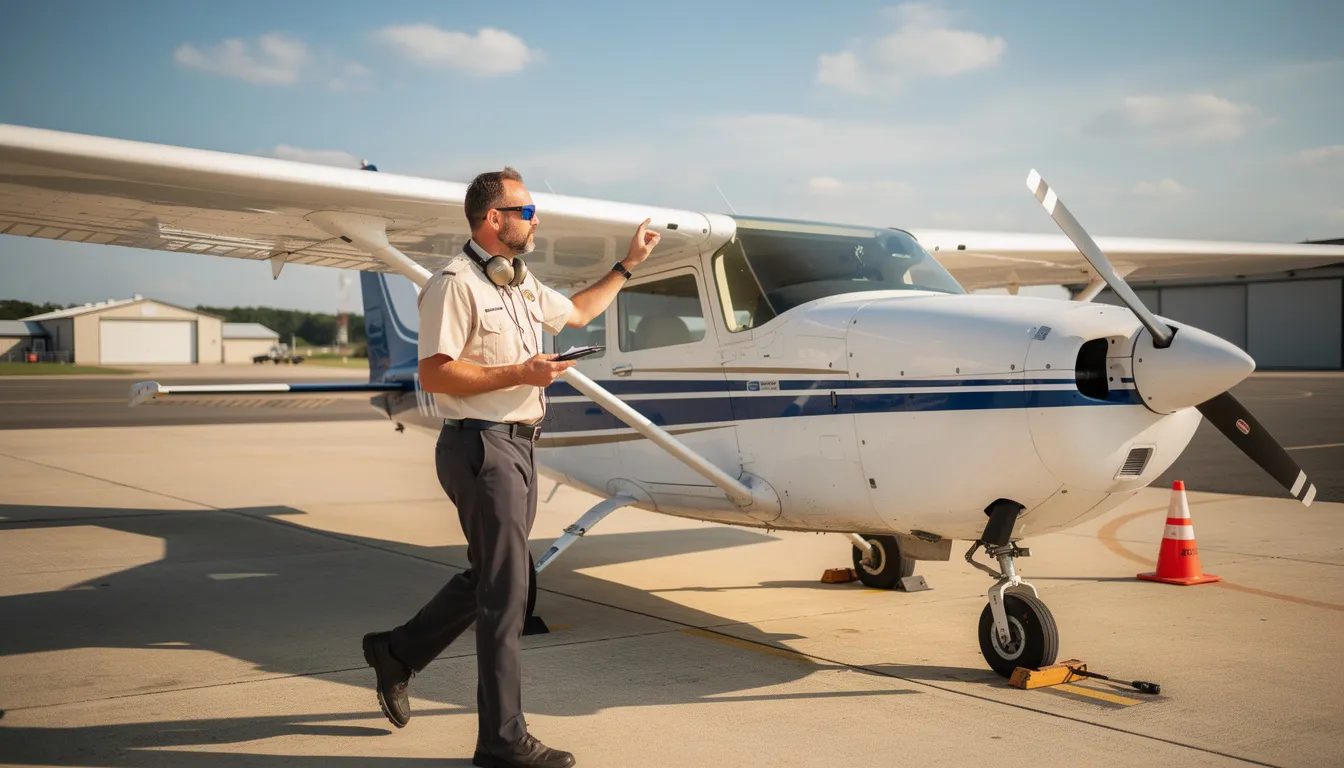
Cessna 172 Safety Record: A Complete Analysis
Dec 24, 2025
Discover why the Cessna 172 boasts one of the strongest safety records in aviation history. From its forgiving flight characteristics to decades of proven reliability, this legendary trainer remains the go-to aircraft for flight schools and private pilots alike.
Dive into the facts behind the Cessna 172 safety record and learn what makes it so trusted worldwide.
Quick Answer: How Safe Is the Cessna 172?
The Cessna 172 is a Skyhawk that has managed to keep its fatal accident rate pathetically low. Stats from the AOPA Air Safety Foundation show a fatal accident rate of around 0.56 accidents per 100,000 flight hours about half that of the industry average for these types of light single engine planes.
Now let's put that into perspective: for the general average of GA single-engine piston aircraft, you're looking at about 1.2 to 1.4 fatal accidents per 100,000 hours flown. And still, the Cessna 172 manages to blow the competition out of the water, regularly performing way above and beyond the industry benchmark.
Learn more in Flight Nerd Air Force: Aviation Training
Here’s what the numbers tell us
|
Metric |
Cessna 172 |
GA Single-Engine Average |
|---|---|---|
|
Fatal accident rate (per 100,000 hrs) |
0.56 |
1.2–1.4 |
|
Pilot error as accident cause |
~85% |
~83% |
|
Mechanical failure as cause |
<7% |
Higher |
|
Fuel starvation incidents |
~1/3 of comparable aircraft |
Baseline |
The massive worldwide fleet and millions of accumulated hours make these statistics meaningful, not a statistical fluke. When accidents occur in a Cessna 172, they’re overwhelmingly attributed to decision-making errors by pilots involved including weather judgment, fuel mismanagement, and low-level maneuvering rather than structural or mechanical failure.
This strong safety record stems from a combination of factors: inherently stable flight characteristics, simple systems that reduce pilot workload, and widespread use in structured training environments where instructors provide additional safety oversight.
Design Features That Support a Strong Safety Record
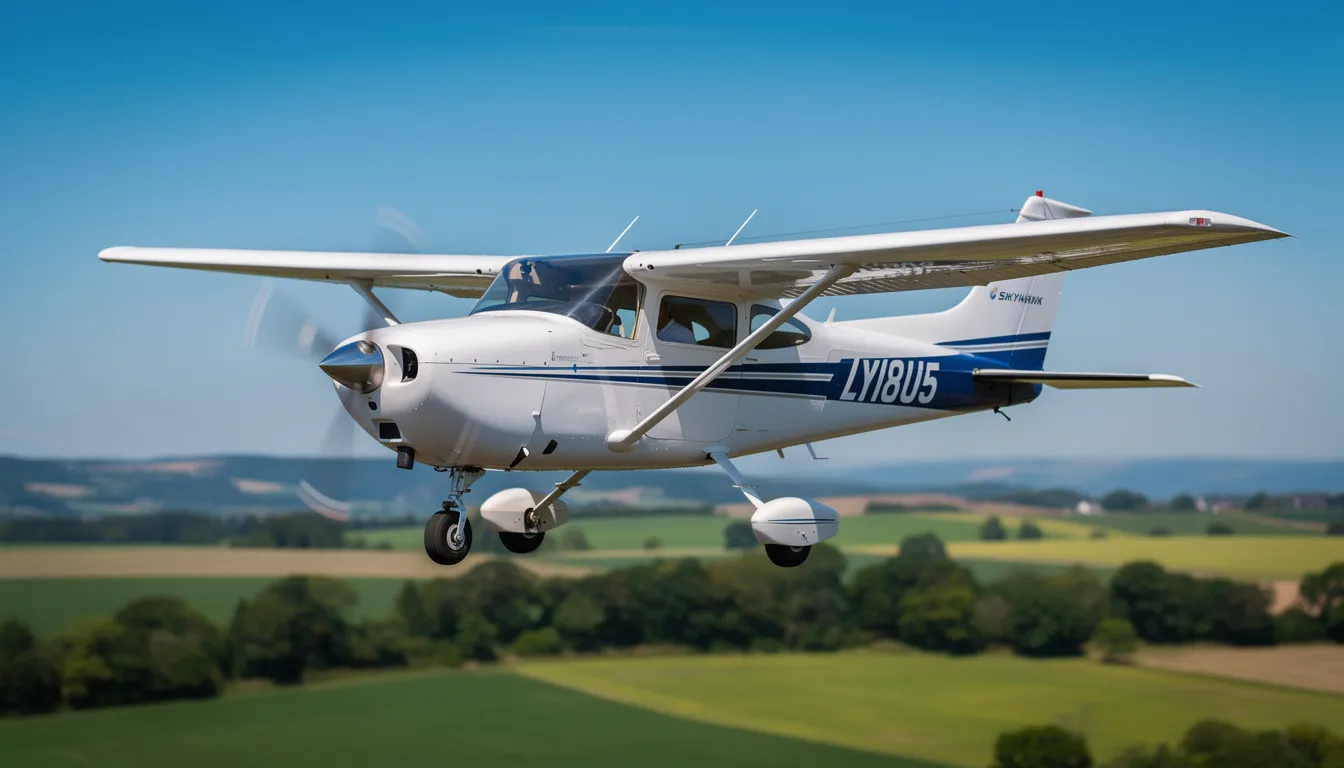
The Cessna 172’s safety reputation isn’t accidental it’s engineered into every aspect of the aircraft, with each design choice intentionally supporting long-term flight safety. From the high-wing layout to the fixed gear, these features create an airplane that’s remarkably tolerant of pilot errors.
High-wing configuration
The strut-braced high wing provides excellent downward visibility for traffic scanning, ground reference maneuvers, and pattern work.
More importantly, the high wing creates inherent roll stability the aircraft naturally wants to return to wings-level flight when disturbed. In off-field landing scenarios, the wing positioned above the cabin offers some protection for occupants.
Fixed tricycle landing gear
There’s no gear handle to forget, no squat switches to fail, and no hydraulic system to malfunction. The fixed gear eliminates an entire category of accidents that plague retractable aircraft.
The gear legs themselves are designed to absorb energy in hard landings, reducing damage to the airframe and protecting occupants. This simplicity makes the 172 a popular airplane for students who have enough to manage without worrying about gear position.
Low stall speed and benign stall behavior
With a stall speed in the low 40-knot range in landing configuration (approximately 48 KCAS clean), the 172 gives pilots more time and altitude to recover from slow-flight errors.
The stall itself is relatively gentle a nose drop with minimal wing rock rather than the aggressive break some other airplanes exhibit. This forgiving stall characteristic has saved countless students from more serious consequences.
Robust airframe construction
Many Cessna 172s have endured tens of thousands of training landings over decades of service. The conservative structural margins built into the design mean that properly maintained aircraft continue passing annual and 100-hour inspections well past their 50th birthday. This durability translates directly to safety.
Simple fuel system
The high-wing design allows gravity feed from the wing tanks to the engine on most models, reducing dependence on fuel pumps. The left/right/both tank selection is straightforward compared to multi-tank systems in other aircraft.
AOPA data shows the 172 experiences approximately one-third the fuel starvation accidents of comparable aircraft that require more complex tank switching a direct result of this simpler design.
Safety Record: Historical and Comparative Analysis
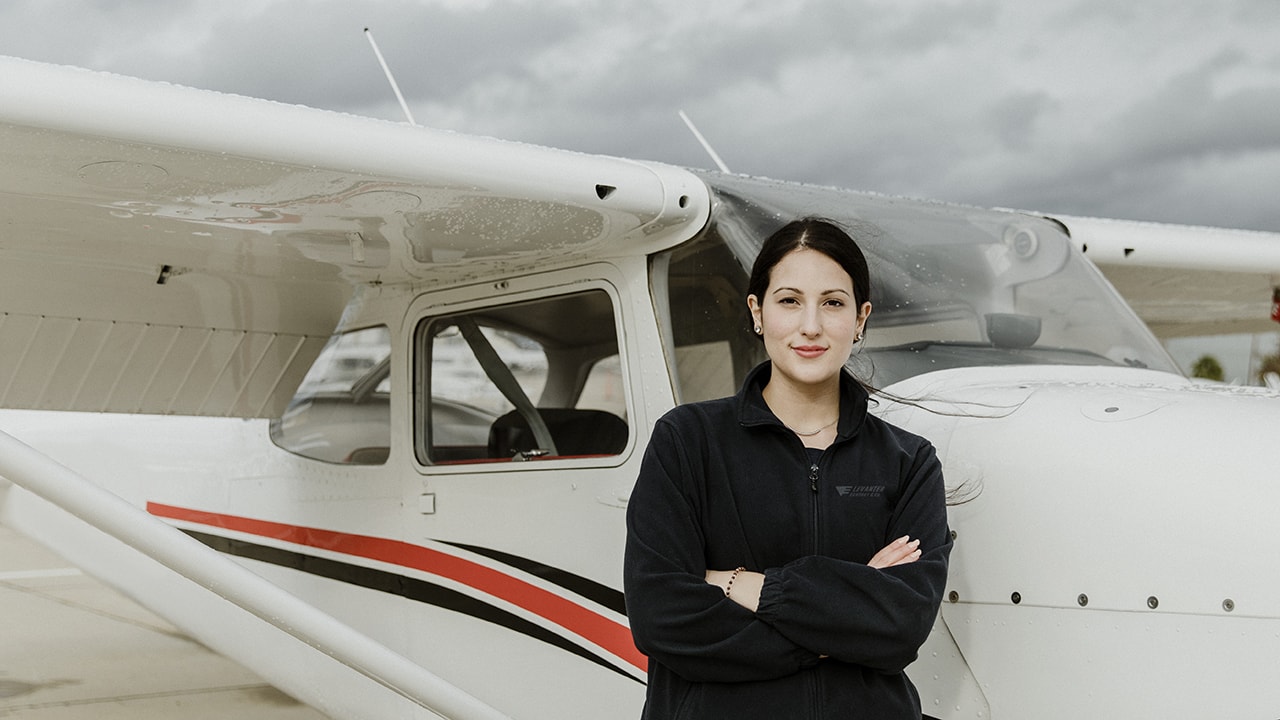
Numbers tell the story better than marketing claims ever could. Let’s examine what the data actually shows about the Cessna 172 compared to other airplanes in its class.
Historical fatal accident rate data
The AOPA Air Safety Foundation did some deep diving into safety analysis a study on 1,600+ Cessna 172 accidents between 1982 and 1988 turned up some pretty interesting numbers. And what they found puts the 172 up there as one of the safest GA planes ever built - a fatal accident rate of around 0.56 per 100,000 flight hours.
This long-term performance didn’t happen by chance; it traces back to an airframe and flight characteristics refined through multiple successful test flights before the aircraft ever entered widespread training and civilian service, helping explain why platforms like the Cessna 172 have earned the trust of flight schools and professional operators alike, including organizations such as California Highway Patrol.
Comparative performance
|
Time Period |
Cessna 172 Fatal Rate |
GA Single-Engine Average |
|---|---|---|
|
1982-1988 |
0.56/100K hours |
1.2-1.4/100K hours |
|
1990s-2000s |
Similar advantage maintained |
Gradual improvement |
|
2010s-2020s |
At or better than average |
Continued downward trend |
The 172’s advantage holds across different measurement methods whether calculated per 100 aircraft in the fleet or per 100,000 hours of flight, it consistently shows a slight edge over comparable light aircraft like the Piper Cherokee and Beech Musketeer.
Understanding the numbers
Accident rate per 100,000 hours is more informative than raw crash counts because the Cessna 172 fleet is far larger and flies more total hours than most types.
With roughly 24,000 aircraft in the active U.S. fleet during peak periods, the 172 sees more than four accidents per week in absolute terms over 237 annually. However, most of these accidents result in little or no injury to occupants.
Risk varies by mission
And the thing to remember is that not all 172 flights are created equal. Training flights, for instance, are generally a lot safer than long cross country flights or those at night.
That's because of all the built-in safety measures you have with instructor oversight and conservative weather minimums. That really helps to bring down the risk of serious accidents.
We've seen a lot of progress since then overall GA accident rates have gone down across the board. And amazing to note, the Cessna 172 has stayed right on track or even beaten the average proof that this design is pretty darn solid, and that the folks who maintain these planes know what they're doing.
Pilot Experience, Training Use, and Safety Outcomes
The Cessna 172’s safety record cannot be separated from its primary role as a training aircraft. A large proportion of worldwide 172 hours are flown in structured environments Part 61 and Part 141 flight schools, where many students log their earliest hours toward earning a private pilot's license and begin learning How to Fly Cessna 172 under the supervision of qualified instructors, fundamentally changing the risk equation.
Training vs. personal flying risk
Instructional flying is proportionately much safer than personal flying. Pilots under an instructor’s supervision are less prone to fall victim to high-risk accident scenarios.
The data confirms this: 172s used primarily for training show lower serious accident rates than those operated mainly for personal transport.
Several factors drive this difference:
-
Preflight planning is more thorough when an instructor is involved
-
Weather go/no-go decisions tend to be more conservative
-
Dual-pilot oversight catches errors before they become emergencies
-
Training flights typically stay in local areas with familiar terrain
-
Emergency procedures are practiced regularly, not just during checkrides
Why the 172 excels as a primary trainer
The aircraft’s forgiving stall and spin characteristics help reduce training mishaps during slow-flight and stall practice. A good pilot can demonstrate proper technique, and when students inevitably make errors, the 172’s stability provides a margin for recovery.
Many flight schools favor the 172 for precisely these reasons. The combination of predictable handling, low operating costs, and an excellent safety track record makes it ideal for new pilots learning the fundamentals.
The paradox of training operations
Despite the safety benefits of instruction, training operations still see a high frequency of minor incidents. Hard landings, runway excursions, and prop strikes are common because many hours are flown by beginners still developing skills.
The key distinction is that these incidents rarely result in serious injury the 172’s robust construction tolerates abuse that would damage more delicate aircraft.
Data comparison:
|
Flight Type |
Relative Accident Severity |
|---|---|
|
Instructional flights |
Lower fatality rate per flight hour |
|
Personal flying |
Higher risk, especially in weather |
|
Night operations |
Elevated risk (7.65 vs 6.17 per 100K hours) |
|
IFR flight plan operations |
Lower accident involvement |
Weather, IFR Operations, and the Cessna 172
Weather-related accidents represent some of the most serious mishaps in general aviation. How does the Cessna 172 perform when conditions deteriorate?
IFR training and operations
Later-model 172R and 172S aircraft, especially those equipped with Garmin G1000 glass cockpits, are frequently used for IFR training. The aircraft’s stable handling makes it an excellent platform for learning instrument flying predictable performance in turbulence, approaches, and missed approaches helps students develop skills without fighting the airplane.
However, 172s are used relatively less for long, hard-IFR cross-country trips compared to faster complex aircraft. Pilots who need to “get there” in challenging weather often choose higher-performance platforms.
Favorable IMC accident statistics
The Cessna 172 is involved in accidents in instrument meteorological conditions approximately half as often as other light singles. This favorable comparison isn’t because the 172 is inherently more stable in clouds it’s because of how the aircraft is typically used.
When 172s fly IFR, they’re usually operated by:
-
Instructors training instrument students
-
Experienced instrument-rated pilots building proficiency
-
Pilots making conservative go/no-go decisions
In contrast, aircraft like the Gulfstream Traveler and Beech Musketeer are less commonly used by flight schools. Individual private owners conducting cross country flights in these types face greater exposure to adverse weather.
The VFR-into-IMC problem
When serious weather-related accidents do occur in 172s, they typically involve non-instrument-rated pilots pressing into deteriorating conditions. This is a pilot decision problem, not an aircraft problem.
The research is clear: flying safely in weather requires proper training, equipment, and judgment. The 172 will perform admirably in instrument conditions when flown by qualified pilots on a proper IFR flight plan.
Weather risk-reduction tips for 172 pilots
-
Obtain a thorough weather briefing before every flight
-
Establish personal minimums more conservative than legal minimums
-
If you’re not instrument rated, treat any possibility of IMC as a no-go
-
Use modern weather tools (ADS-B, satellite weather) for in-flight awareness
-
When in doubt, turn around no destination is worth the risk
Weight, Balance, and Performance Safety Considerations
Here’s an uncomfortable truth about the Cessna 172: it has four seats, but you often can’t use them all safely. Understanding weight and balance isn’t just regulatory compliance it’s survival.
The four-seat trap
A fully fueled Cessna 172 with four adults on board can easily reach or exceed maximum takeoff weight, typically around 2,450 to 2,558 pounds depending on model. The math simply doesn’t work for many configurations:
|
Component |
Typical Weight |
|---|---|
|
Basic empty weight |
~1,680 lbs |
|
Full fuel (53 gal) |
~318 lbs |
|
Pilot |
170-200 lbs |
|
Front passenger |
170-200 lbs |
|
Rear passengers (2) |
340-400 lbs |
|
Total |
2,508-2,598 lbs |
That calculation often puts a four-seat configuration at or over maximum gross weight before anyone adds a single bag through the baggage door.
Density altitude dangers
The performance penalty for overloading becomes critical at high density altitude. Hot, high, and humid conditions dramatically increase takeoff roll and decrease climb performance. What looks like adequate runway at sea level on a cool morning becomes dangerously short at 5,000 feet elevation on a summer afternoon.
An overloaded 172 at high density altitude exhibits:
-
Anemic or non-existent climb performance after rotation
-
Stalls occurring at higher-than-normal indicated airspeeds
-
Extended takeoff rolls that may exceed available runway
-
Inability to clear obstacles in the departure path
Center of gravity considerations
The 172’s published CG envelope keeps operations within safe bounds, but pilots should understand the implications. An aft CG produces lighter control forces and slightly better cruise performance, but it also degrades stall behavior the break becomes sharper and recovery takes longer.
Loading fuel in the wing tanks (located near the CG) has less effect than passenger distribution. Two heavy passengers in the rear seats can push CG aft toward the limit, especially as fuel burns off during flight.
Practical weight-and-balance example
Before a cross country flight from Redbird Airport, a pilot plans to carry three passengers and their luggage. Starting weight and balance:
-
Empty weight: 1,680 lbs
-
Pilot + front passenger: 380 lbs
-
Rear passengers: 340 lbs
-
Baggage: 50 lbs
-
Fuel (40 gallons): 240 lbs
-
Total: 2,690 lbs: Over gross weight by 132 lbs
The pilot must either reduce fuel, leave a passenger behind, or accept degraded performance and higher risk. There’s no safe way to cheat the physics.
Why the Cessna 172 Remains a Benchmark for Training Safety
Nearly 70 years after its first flight, the Cessna 172 still dominates flight training worldwide. This isn’t nostalgia or inertia it’s a rational choice based on proven performance.
Why flight schools choose the 172
The combination of factors that makes the 172 successful hasn’t been replicated by competitors:
-
Predictable handling that doesn’t surprise students
-
Robust construction that tolerates the abuse of training operations
-
Low operating costs compared to more complex aircraft
-
An excellent safety track record documented over decades
-
Widespread parts availability and maintenance knowledge
Many flight schools have experimented with alternatives, but most return to the 172 or similar Cessna trainers. The ecosystem of instructors, mechanics, and supporting infrastructure built around this aircraft is unmatched.
The confidence factor
Students often log their very first flight and first solo in a 172. The aircraft’s stability and straightforward systems allow beginners to focus on learning without being overwhelmed by the airplane. This builds confidence at a critical stage of training.
A new student already has enough to manage airspace, communications, weather, navigation, and basic aircraft control. The 172 doesn’t add unnecessary complexity to this workload. The stall speed is forgiving, the landing gear stays down, and the fuel system doesn’t require constant attention.
Modern glass-cockpit variants
The 172S models equipped with Garmin G1000 glass cockpits blend the classic forgiving airframe with advanced situational-awareness tools.
Moving map displays, terrain awareness, traffic information, and comprehensive engine monitoring give students exposure to modern avionics while maintaining the familiar handling characteristics.
This combination proven airframe plus modern technology offers arguably the best of both worlds for primary training.
Benefits for students
-
Forgiving flight characteristics allow focus on learning fundamentals
-
Excellent visibility from high-wing configuration aids traffic scanning
-
Robust construction tolerates minor landing errors without drama
-
Widespread availability means training can continue during travel
-
Skills learned in 172 transfer readily to other aircraft types
-
Instructors and examiners know the aircraft intimately
Practical Safety Tips for Cessna 172 Pilots
Knowledge without application won’t keep you safe. Here’s a practical checklist of best practices for anyone flying the Cessna 172 whether you’re a student on your first solo or a private pilot with thousands of hours.
Preflight and planning
-
Complete a thorough preflight inspection every flight no shortcuts
-
Calculate weight and balance for actual conditions, not “about right”
-
Verify fuel quantity visually; don’t trust gauges alone
-
Check fuel for water contamination at all drain points
-
Review density altitude and calculate takeoff/climb performance
-
Establish personal minimums more conservative than legal minimums
Weather and go/no-go decisions
-
Get a complete weather briefing, not just destination conditions
-
Respect crosswind limitations know your personal limits and the aircraft’s
-
If you’re not instrument rated, treat marginal VFR as a no-go
-
Always have an escape route planned before entering marginal conditions
-
Night operations require extra margins weather can deteriorate quickly
Flight operations
-
Avoid low-level maneuvering for sightseeing or photography
-
Maintain pattern altitude and follow traffic procedures
-
Practice slow flight, stalls, and Go Around Procedure C172 regularly with an instructor
-
Never attempt steep turns or aggressive maneuvers at low altitude
-
Respect the service ceiling and performance limitations at altitude
Currency and proficiency
-
Fly regularly; skills decay faster than you might expect
-
Schedule periodic dual instruction to address bad habits
-
Practice emergency procedures engine failure, electrical failure, systems failures
-
Review the POH before flying unfamiliar 172 variants
-
Consider flight review topics as ongoing training, not annual checkboxes
Technology as a supplement
-
Use weather apps and flight planning software for better situational awareness
-
If equipped with ADS-B, monitor traffic and weather in flight
-
Tablet-based navigation aids are helpful but don’t replace basic pilotage skills
-
Engine monitors (if installed) can provide early warning of developing problems
-
File flight plans for cross-country flights search and rescue needs to know