IAS in Aviation: Indicated Airspeed Explained
May 15, 2026
Indicated airspeed is the speed that shows up right on your plane's airspeed indicator and still, in 2026, it's the main speed that pilots rely on for real world flying and training missions.
When you look at that dial, the speed you see is the IAS in knots no corrections applied, just the raw number.
Understanding IAS in aviation matters because it directly links to stall prevention, V-speeds, and compliance with airspace speed limits like 250 KIAS below 10,000 ft MSL.
While calibrated airspeed, true airspeed, equivalent airspeed, Mach number, and ground speed all have their roles, IAS is what you fly by.
It’s tied to aerodynamic forces lift, drag, and control effectiveness not to how fast the aircraft moves over the ground.
What Is Indicated Airspeed (IAS)?
Indicated airspeed IAS is the airspeed value shown on the airspeed indicator, derived from the aircraft’s pitot static system measuring dynamic pressure. This direct instrument reading represents the aircraft relative speed to the surrounding air mass.
IAS is uncorrected for instrument errors, position errors, compressibility effects, altitude, or temperature deviations from the international standard atmosphere.
The speed displayed assumes sea level conditions at 15°C and standard atmospheric pressure.
These days most aircraft show their IAS in knots (KIAS) although some older trainers still used mph.
And when talking about critical flight speeds like the stall speed (VS), the max speed with certain flap settings (VFE), the speed for aerobatics (VA), and the absolute top speed your plane can hit (VNE) all those are expressed in IAS because they relate to the aerodynamics and the plane's actual structure.
Whether you're flying a little Cessna 172S or a big Boeing 737-800 pilots always refer to the IAS, and that's because the airspeed indicator gives you a sense of how the air is treating your plane in other words how the dynamic pressure is reading.
And that's a pretty crucial bit of info to have especially when you consider how it can make all the difference when it comes to flight safety, regardless of whether you're flying a prop or a jet.

How the Pitot-Static System and Airspeed Indicator Work
The pitot tube usually stuck up on the wing or nose of the aircraft, captures the pressure when its in the air - a mix of the actual pressure outside and the pressure created as the plane hurtles through the air at speed.
Meanwhile, static ports dotted around the fuselage just sense the pressure of the air around it, like the weather outside.
Inside the Airspeed Indicator, the instrument works out the difference between that total pressure (from the pitot tube) and the static pressure (from those static ports) and uses that to get the dynamic pressure of the air.
Dynamic pressure is made up of how dense the air is and how fast your plane is going, all according to this pretty simple formula where pressure is equal to half the density of air multiplied by the speed of the plane all squared.
In a traditional analog ASI, a diaphragm expands or contracts with this pressure difference, moving mechanical linkages that rotate the needle. The instrument is calibrated to convert that pressure differential into indicated knots, providing accurate measurement of relative velocity through the air.
Any blockage creates problems. Pitot icing during winter operations, insect contamination during summer storage, or debris can cause misleading airspeed readings.
A blocked pitot tube may freeze the indication, drop it to zero, or create erratic behavior scenarios that have contributed to historical accidents.
IAS vs Other Types of Airspeed
Student pilots must distinguish between five airspeed definitions before solo cross-country flights. Each type corrects for different effects: installation and instrument errors, compressibility effects, altitude, temperature, and wind conditions.
If you’re also researching how many hours for IFR rating, understanding these airspeed types early will make instrument training, flight planning, and approach work easier to manage.
Calibrated Airspeed (CAS): IAS corrected for position errors and installation error. In a Cessna 172 or Piper PA-28 at cruise, CAS is typically within a few knots of IAS.
True Airspeed (TAS): Calibrated airspeed CAS corrected for non-standard air density the actual speed through the air mass. True airspeed TAS is used for flight planning and fuel planning since it represents actual distance covered.
Equivalent Airspeed (EAS): CAS corrected for compressibility effects, relevant above 200-250 KIAS and at higher altitudes. Fast jets use EAS for structural calculations where actual density matters.
Mach Number: TAS divided by local speed of sound, crucial above FL250 for jet transports where compressibility effects become significant.
Ground Speed: TAS adjusted for wind effect. You might see 120 KIAS and 150 knots GS simultaneously in a 30-knot tailwind. Ground speed tells you navigation information, but IAS determines aircraft performance and flight performance.
Why IAS Matters in Real Flight Operations

IAS is a key part of every single flight phase and is pretty much a direct requirement for talking to air traffic control.
Takeoff: When it comes to taking off in a Cessna 172R, pilots need to rotate at a specific IAS usually around VR 55 KIAS in order to get off the ground safely, regardless of the density altitude or whether there's any wind around.
Climb and Cruise: Your best rate-of-climb speed (VY) , best angle-of-climb speed (VX) , and cruise climb speed are all IAS, which is really handy for keeping track of engine cooling and getting obstacles out of the way.
Plus, it makes sure your flight is as efficient as possible - even in all sorts of different conditions.
Approach and Landing: Final approach speeds for conferences like VREF for jets and VFE for certain flap settings are all IAS values.
Keeping to the right approach speed helps prevent stalls and makes sure you don't go over structural limits, and that directly affects how long your landing is going to be.
Structural Limits: VNE and VA are defined in IAS because they correspond to dynamic pressure forces on the airframe, not TAS or groundspeed.
Regulatory Compliance: Speed limits like 250 KIAS below 10,000 ft MSL are specified in IAS because it's the speed that pilots are actually going to see and control their airplane at.
Pilots studying instrument rating privileges and limitations should also understand IAS because IFR operations require precise speed control, approach planning, and compliance with published limitations.
Turbulence: When you hit turbulence pilots tend to slow down to the published turbulence penetration speeds in IAS so the loads on the airframe stay well within the certified limits.
Reading and Interpreting the Airspeed Indicator
Understanding your displays prevents dangerous misreadings during high-workload situations.
Analog ASI Color Coding:
-
White arc: Flap operating range (40-85 KIAS on a 172S)
-
Green arc: Normal operating range (48-129 KIAS)
-
Yellow arc: Caution range, smooth air only
-
Red line: VNE, never exceed (163 KIAS)
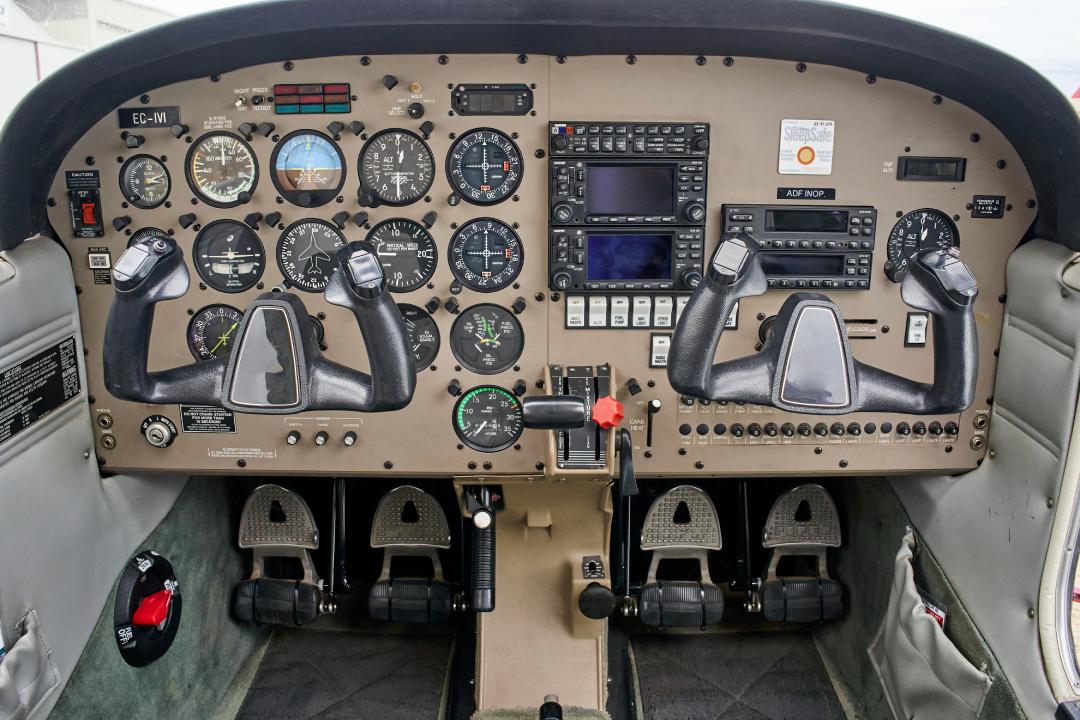
Modern Primary Flight Displays show IAS on a vertical tape with some nice to know numbers and trend vectors to help you read between the lines. Some Garmin G1000 or G3X displays will also show the same info in digital format, because why not.
Regardless of what it looks like on your display, the value is still coming from the pitot-static system that's not GPS groundspeed.
Next time you're flying level at 2,400 RPM, take a glance at your attitude and power. On a standard day in a 172 you can expect around 100 KIAS - but don't quote me on that.
Common errors include confusing knots and mph, misinterpreting color arcs, or fixating on GPS groundspeed during approaches when IAS varies considerably from GS due to wind.
IAS, Altitude, Temperature, and Compressibility
IAS and TAS diverge significantly with altitude increases, though the aircraft responds to IAS regardless of this relationship.
As the altitude goes up and the air gets thinner, or as air density decreases, the same IAS that was doing just fine at lower altitudes is going to start to require a higher TAS to keep you at the same speed.
And it's not a bad rule of thumb to remember that TAS increases about 2% for every 1000 feet of altitude gain above sea level that's just a rough guess though. At 8,000 feet, for example, 120 knots IAS is going to look more like 140 KTAS you're actually covering more ground with the same speed reading on your airspeed indicator.
Temperature affects this relationship because it changes atmospheric density. The assumed value in ASI calibration is ISA: 15°C at sea level, decreasing with pressure altitude.
Compressibility effects matter at higher speeds and altitudes where air compresses ahead of the pitot tube. This causes IAS to read higher than EAS.
For typical training aircraft below 10,000 ft and under 160 KIAS, compressibility error is negligible convert IAS to TAS without worrying about EAS corrections.
Common Errors, Failures, and Safety Considerations
Recognizing system failures early can prevent accidents.
Instrument and Position Error: Airflow disturbances around the fuselage affect static port readings. POH charts provide IAS-to-CAS corrections, though these differences vary considerably at low airspeeds or high angles of attack.
Blocked Pitot Tube: Insect nests during warm-weather storage or ice accretion without pitot heat can freeze readings, drop them to zero, or create erratic indications. Calculating airspeed becomes impossible without reliable pitot input.
Blocked Static Port: Affects IAS, altimeter, and VSI simultaneously. The airspeed indicator shows frozen or incorrect values relative to actual conditions.
Mitigation strategies:
-
Activate pitot heat in visible moisture and temperatures below 10°C
-
Compare IAS with pitch/power expectations
-
Use alternate static source if available
-
Transition to pitch-and-power flying if instruments seem unreliable
Flight training syllabi in 2024-2026 emphasize early recognition of unreliable airspeed and performance calculations based on known power settings rather than instrument readings.
IAS in Pilot Training and Exam Preparation
Pilot training written tests commonly ask about IAS definitions, differences from groundspeed, why V-speeds use IAS, and how to estimate TAS from IAS at given altitudes.
Memorize your training aircraft’s V-speeds in KIAS: VS, VSO, VX, VY, VFE, VA, VNO, and VNE. Practice converting between IAS, CAS, and TAS using POH charts and E6B flight computers before cross-country flights.
Modern simulator platforms like X-Plane and MSFS 2024 let you visualize IAS behavior with changing altitude and configuration. Confidence in IAS interpretation supports safer solo flights and smoother transitions to complex aircraft.