FAA PPL: Requirements, Costs & Testing Guide
Apr 07, 2026
Earning your FAA private pilot license opens the door to flying aircraft for personal travel, recreation, and adventure.
Whether you’re dreaming of weekend flights to coastal destinations or simply want the freedom of the skies, understanding what the FAA requires is your first step.
This guide breaks down every requirement for the FAA PPL from medical certification to checkride preparation with concrete numbers and practical examples.
Quick Answer: What You Need for an FAA Private Pilot License (PPL)
The FAA private pilot certificate represents the foundational credential for recreational flying and serves as a prerequisite for advanced certifications like the instrument rating or commercial pilot certificate.
Here’s what you need to know upfront, especially if you’re already thinking about PPL vs CPL and how your training path might evolve.
Core eligibility requirements:
-
Minimum age of 17 years old for the airplane category (16 for glider or balloon)
-
Ability to read, speak, write, and understand English
-
U.S. citizenship or TSA approval for non-citizens
-
Hold or be in the process of obtaining a student pilot certificate, sport pilot certificate, or recreational pilot certificate
The FAA establishes a legal minimum of 40 hours total flight time under Part 61 regulations. However, this number is a floor, not a realistic expectation. Most students complete their private pilot certification with 60 to 75 hours of flight time.
The gap exists because developing consistent proficiency in complex skills like landings, navigation, and emergency procedures simply takes more practice than the minimum allows.
All private pilot requirements are defined in 14 CFR §61.103 through §61.113, while the specific tasks and standards for the checkride appear in the current Private Pilot Airman Certification Standards document.
This article will walk you through testing procedures, medical requirements, required training hours, and ongoing currency obligations with specific numbers and examples to help you plan your training.
FAA Testing Requirements for the Private Pilot Certificate
The testing framework for earning your private pilot certificate is established under 14 CFR 61.103(d) and related sections.
Two distinct evaluations stand between you and your certificate: the required knowledge test and the required practical test, each requiring specific instructor endorsements.
The FAA Knowledge Test (Written Exam)
The FAA knowledge test is a computer-based examination administered at authorized testing centers like PSI. Here are the specifics:
-
Format: 60 multiple-choice questions
-
Time limit: 2.5 hours
-
Passing score: 70% (42 correct answers)
-
Typical fee: $100–$200 depending on testing provider
-
Validity: Results valid for 24 calendar months
Before sitting for the exam, you need a logbook endorsement from an authorized instructor or completion certificate from an FAA-approved Part 141 school, confirming you’ve received ground training in all required aeronautical knowledge areas.
Common subject areas on the knowledge test:
-
Federal aviation regulations (Parts 61 and 91)
-
NTSB accident reporting rules
-
Principles of flight and aerodynamics
-
Weight and balance calculations
-
Aircraft systems and powerplant
-
Aeronautical weather reports and meteorology
-
Navigation using charts and radio aids
-
Radio communication procedures
-
Airspace classifications and requirements
The Practical Test (Checkride)
The private pilot practical test commonly called the checkride is conducted by an FAA designated pilot examiner and consists of two portions:
Oral examination (1.5–2 hours): The examiner asks scenario-based questions to assess your understanding of regulations, aircraft systems, weather interpretation, navigation planning, and emergency procedures.
Flight examination (1.5–3 hours): You demonstrate flight proficiency across tasks defined in the Airman Certification Standards, including steep turns, stalls, ground reference maneuvers, takeoffs and landings, navigation, and emergency procedures.
The total checkride typically takes 3 to 5 hours. You must pass the knowledge test before attempting the checkride, and both exams require separate instructor endorsements confirming your readiness.
Eligibility & Medical Certificate Requirements
Core eligibility for the private pilot certificate is codified in 14 CFR 61.103. Beyond meeting training requirements, you must satisfy these baseline criteria.
Age Requirements
-
Private Pilot Airplane: At least 17 years old at the time of the practical test
-
Solo Flight: At least 16 years old to solo as a student pilot
-
Glider or Balloon: At least 16 years old for certificate issuance
You can begin flight training before reaching these ages the minimums apply specifically to solo privileges and certificate issuance.
Medical Certificate Requirements
To exercise private pilot privileges, you must hold at least a third class medical certificate issued by an FAA Aviation Medical Examiner. The medical examination covers:
-
Vision: Distant visual acuity of at least 20/40 in each eye, with or without correction
-
Hearing: Ability to hear conversational voice at 6 feet
-
Cardiovascular: Blood pressure evaluation and cardiac history review
-
Mental health: Assessment of psychological conditions
-
Medications: Disclosure of all current prescriptions
Validity periods for third class medical certificate:
|
Your Age at Issuance |
Certificate Valid For |
|---|---|
|
Under 40 years old |
60 calendar months (5 years) |
|
40 years or older |
24 calendar months (2 years) |
The certificate expires on the last day of the final month of the validity period. A medical examination issued March 15, 2024 to a 38-year-old expires March 31, 2029.
BasicMed Alternative
BasicMed provides an alternative pathway for pilots who held a valid FAA medical certificate after July 14, 2006. Instead of visiting an AME, you complete a Comprehensive Medical Examination Checklist with any state-licensed physician and take an online BasicMed course every 24 calendar months.
BasicMed operating limitations:
-
Maximum certificated takeoff weight: 6,000 lbs
-
Maximum passengers: 5 plus pilot
-
Maximum altitude: 18,000 feet MSL
-
Maximum speed: 250 knots indicated airspeed
-
No operations for compensation or hire
BasicMed works well for recreational pilots flying modest aircraft but won’t suffice if you plan to pursue commercial operations.
Aeronautical Knowledge & Ground Training
Aeronautical knowledge requirements are specified in 14 CFR 61.105 and form the theoretical foundation for safe flight operations. How you acquire this knowledge depends on your training pathway.
Required Knowledge Areas
You must receive instruction and demonstrate understanding in these areas:
-
Federal aviation regulations applicable to private pilots
-
NTSB Part 830 accident and incident reporting
-
Principles of flight (lift, drag, thrust, weight)
-
Weight and balance computation
-
Aircraft systems (engine, electrical, fuel, flight controls)
-
Preflight preparation and performance calculations
-
Meteorology and weather interpretation
-
Navigation using pilotage, dead reckoning, and radio aids
-
Radio communication procedures
-
Airspace classifications and requirements
-
Critical weather situations recognition
-
Aeronautical decision-making and risk management
Part 61 vs. Part 141 Ground Training
Part 61 training offers flexibility. You can use self-study materials textbooks, video courses, online platforms combined with instructor-led sessions. There are no minimum ground instruction hours; you simply need an authorized instructor to endorse that you’ve completed training and are ready for the knowledge test.
Part 141 training requires enrollment in an FAA-approved flight school with a structured syllabus and formal stage checks. These programs typically specify 20–30 hours of ground school and provide a graduation certificate for test authorization.
Practical Study Approach
Most successful students log ground training through a hybrid approach:
-
Complete a structured online course or textbook program (4–6 weeks)
-
Use practice test software to identify weak areas
-
Schedule one-on-one sessions with a certificated flight instructor for challenging topics
-
Conduct final review in the 1–2 weeks before the exam
Plan for 30–40 hours of focused ground study spread over 6–8 weeks before attempting the written test.
Flight Proficiency & Required Flight Hours
Flight training requirements are established in 14 CFR 61.109 for airplane single-engine land ratings. Understanding the difference between regulatory minimums and realistic expectations will help you budget time and money appropriately.
FAA Part 61 Minimum Requirements
|
Requirement |
Minimum Hours |
|---|---|
|
Total flight time |
40 hours |
|
Dual instruction (with CFI) |
20 hours |
|
Solo flight |
10 hours |
|
Cross country flight training |
3 hours |
|
Night flight training |
3 hours |
|
Basic instrument maneuvers training |
3 hours |
|
Pre-checkride training (within 2 months) |
3 hours |
Reality check: The 40-hour minimum is what regulations allow not what most people need. Expect 55–75 hours total to develop the proficiency the Airman Certification Standards demand.
Part 141 School Minimums
Part 141 flight schools may operate under reduced minimums (often 35 hours total) due to their structured syllabi and stage checks. However, actual completion times remain similar because proficiency standards don’t change based on training pathway.
What Examiners Evaluate
Beyond logged hours, the DPE assesses:
-
Stabilized approaches and consistent landings
-
Safe and efficient operation of aircraft systems
-
Effective radio communication
-
Sound aeronautical decision-making
-
Ability to manage slow flight and stall recovery
-
Navigation accuracy using multiple methods
Hours are opportunities to practice; proficiency is what earns the certificate.
Flight Instruction (Dual Training Requirements)
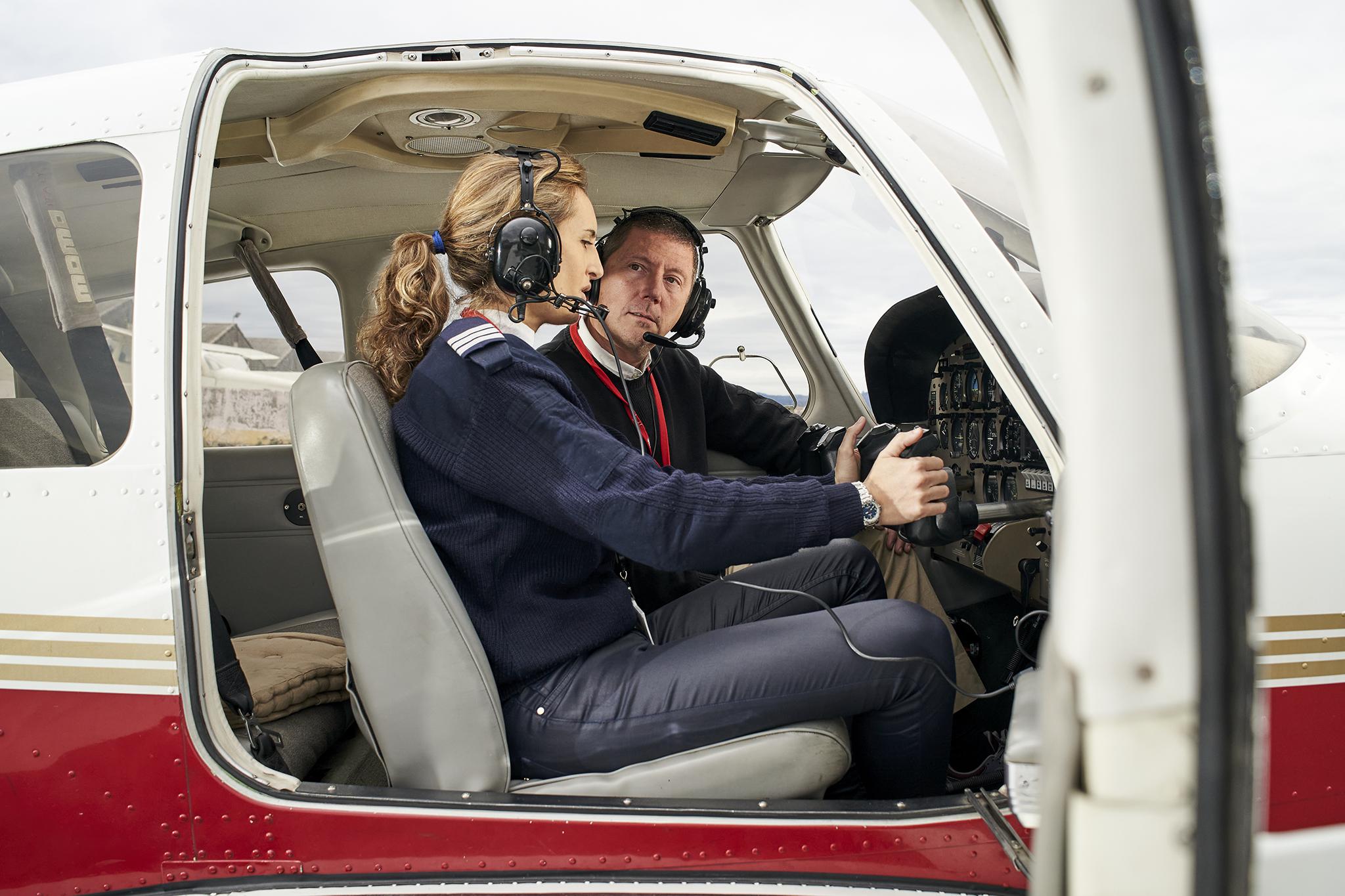
At least half of your minimum flight time must be dual instruction with a certificated flight instructor. These 20 hours cover specific training categories mandated by regulation.
Breakdown of Dual Requirements
Cross country flight training (minimum 3 hours): Flights over 50 nautical miles teaching preflight preparation, navigation, ATC communication, and fuel planning.
Night flight training (minimum 3 hours): Must include one cross country flight over 100 nautical miles total distance and 10 takeoffs and full stop landings each landing involving a flight in the traffic pattern at night.
Basic instrument maneuvers training (minimum 3 hours): Flying the aircraft solely by reference to instruments, developing skills essential for inadvertent IMC encounters.
Pre-practical test training (minimum 3 hours): Must occur within 2 calendar months before your checkride, focusing on ACS tasks and checkride preparation.
What Dual Training Covers
During flight instruction sessions, your flight instructor teaches:
-
Normal, short-field, and soft-field takeoffs and landings
-
Slow flight at minimum controllable airspeed
-
Power-on and power-off stalls
-
Steep turns (typically 45-degree bank)
-
Ground reference maneuvers (S-turns, turns around a point)
-
Emergency procedures (simulated engine failures, system malfunctions)
-
Navigation using charts, VOR, and GPS
-
Radio communication with ATC
Example scenario: Your instructor reduces power to idle at 3,000 feet AGL and announces “Engine failure.” You immediately establish best glide speed, select a suitable landing location, troubleshoot the emergency checklist, and plan your approach all while the instructor evaluates your decision-making and aircraft control.
Solo Flight & Cross-Country Experience
Solo flight marks a transformational milestone. Flying alone for the first time responsible for every decision builds the confidence and judgment essential for safe piloting.
Solo Requirements Under Part 61
|
Requirement |
Specification |
|---|---|
|
Total solo flight time |
10 hours minimum |
|
Solo cross country time |
5 hours minimum |
|
One solo cross country |
150 nautical miles total, landings at 3 points |
|
Longest leg |
At least 50 nautical miles straight line distance |
|
Towered airport |
3 takeoffs and landings to a full stop at airport with operating control tower |
Before any solo flight, you need a student pilot certificate, current medical certificate, and specific endorsements in your logbook from your authorized instructor.
Meeting the Cross-Country Requirement
Here’s an example 170 nautical mile solo cross country flight meeting requirements:
Route: Departure airport → Airport B (60 NM) → Airport C (55 NM) → Home airport (55 NM)
-
Full stop landings at three separate takeoff and landing locations
-
Leg from departure to Airport B exceeds 50 NM straight line distance
-
Total distance exceeds 150 NM requirement
Your flight instructor will plan progressively longer solo cross country flights before endorsing you for the 150 NM requirement. A typical progression:
-
Initial supervised pattern work at home airport
-
First solo flight consisting of three takeoffs and landings
-
Local solo flights within 25 NM radius
-
Supervised dual cross-country flights
-
Short solo cross-country (50–80 NM)
-
Long solo cross-country (150+ NM)
Part 141 programs may require only 5 hours solo time, but most students exceed minimums to reach proficiency regardless of training pathway.
Knowledge Test Logistics: FTN, Identification & Authorization
Taking the FAA knowledge test requires proper registration, documentation, and authorization. Here’s the process.
Federal Tracking Number (FTN)
Before scheduling your exam, obtain an FTN through the IACRA (Integrated Airman Certification and Rating Application) system. This unique identifier links your personal information, medical records, and test results in FAA databases.
Required Identification
Bring government-issued photo ID with signature, date of birth, and physical address:
-
U.S. driver’s license
-
U.S. passport
-
Foreign passport with visa or Permanent Resident Card
-
Permanent Resident Card (Green Card)
The ID must be current and match your legal name exactly.
Test Authorization
You need one of these to sit for the exam:
-
Logbook endorsement from your certificated flight instructor (Part 61)
-
Graduation certificate from an FAA-approved Part 141 school
-
FAA-issued authorization for special circumstances
Retest Procedures
Failed the test? You must wait 30 calendar days before retaking unless your instructor provides a new endorsement certifying additional training in deficient areas, which allows immediate retesting.
When scheduling at PSI or another designated provider, bring your confirmation email, required ID, and if retesting, your Airman Knowledge Test Report from the previous attempt.
Practical Test (Checkride) Prerequisites & Documents
The checkride represents your final evaluation. Meeting all prerequisites and arriving with proper documentation ensures a smooth process.
Personal Prerequisites
-
Completed all required ground and flight training per 14 CFR 61.109
-
Passed knowledge test within previous 24 calendar months
-
Received instructor endorsement for practical test readiness
-
Reached minimum age of 17 for airplane category
Aircraft Requirements
Your checkride aircraft must have:
-
Valid airworthiness certificate
-
Current registration
-
Pilot’s Operating Handbook with operating limitations
-
Current weight and balance documentation
-
All required equipment operational
-
Current annual inspection (and 100-hour if applicable)
-
Transponder certification within 24 months
-
Static system/altimeter check within 24 months
Documentation Checklist
Bring these items to your checkride:
|
Document |
Purpose |
|---|---|
|
Pilot logbook |
Shows all flight time and endorsements |
|
Student pilot certificate |
Proves eligibility |
|
Medical certificate |
Confirms medical fitness |
|
Airman Knowledge Test Report |
Validates written exam passage |
|
Government photo ID |
Identity verification |
|
Aircraft maintenance logs |
Proves airworthiness |
|
IACRA application (8710-1) |
Official certificate application |
Checkride Flow
Pre-test paperwork (30 minutes): Complete IACRA application, present documentation for examiner review.
Oral examination (1.5–2 hours): Scenario-based questions covering:
-
“You’re planning a flight and notice the weather shows a 2,000-foot ceiling. What regulations apply?”
-
“Explain the airspace around this Class C airport and required equipment.”
-
“Your alternator light illuminates in cruise. What’s your procedure?”
Preflight inspection: Demonstrate thorough aircraft inspection while examiner observes.
Flight portion (1.5–3 hours): Execute maneuvers including steep turns, stalls, ground reference maneuvers, navigation, short-field takeoff and landing, and simulated emergencies.
Debrief: Review performance, receive either temporary airman certificate or notice of disapproval.
Privileges, Limitations & Ongoing Currency
Your new private pilot certificate grants significant freedom with specific limitations and ongoing requirements.
Private Pilot Privileges
Under 14 CFR 61.113, you may:
-
Act as pilot-in-command of aircraft in your same category and class
-
Carry passengers for non-commercial purposes
-
Share aircraft operating expenses (fuel, oil, airport fees, rental) pro-rata with passengers
-
Fly aircraft for personal business transportation
-
Participate in certain search and location operations
-
Conduct charitable flights under defined conditions
Explicit Limitations
You may NOT:
-
Fly for compensation or hire (with limited exceptions)
-
Act as a required crewmember for airlines
-
Conduct commercial operations without a commercial pilot certificate
-
Carry passengers for payment These limitations are why many pilots eventually start asking how much does a CPL cost when they decide to turn flying into a professional career.
Document Requirements
When acting as PIC, keep readily accessible:
-
Pilot certificate
-
Medical certificate (or BasicMed documentation)
-
Government-issued photo ID
Flight Review Requirement
Every 24 calendar months, complete a flight review with an authorized instructor:
-
Minimum 1 hour ground instruction (regulations, procedures)
-
Minimum 1 hour flight instruction (maneuvers appropriate to certificate)
The flight review isn’t a test it’s a professional consultation to verify currency and identify areas for improvement.
Passenger-Carrying Currency
To carry passengers, you must have completed within the preceding 90 days:
-
3 takeoffs and 3 landings in same category, class, and type (if required)
-
For night operations: landings must be full stop landings between 1 hour after sunset and 1 hour before sunrise
Currency vs. Proficiency
Meeting minimum currency requirements makes you legal not necessarily proficient. Recreational pilots who fly infrequently should:
-
Practice landings more often than the 90-day minimum
-
Schedule occasional refresher training
-
Review regulations and procedures regularly
-
Consider instrument-like practice even for VFR flying
