ACS Private Pilot Study Guide for Checkride Prep
Jun 15, 2026
Ready to ace your private pilot checkride? Our comprehensive ACS Private Pilot Study Guide breaks down the FAA's latest standards into clear, manageable sections.
Whether you're prepping for the oral exam or perfecting flight maneuvers, this guide equips you with the knowledge, risk management, and skills to fly confidently and pass with ease.
Understanding the Airman Certification Standards (ACS)
So the airman certification standards came in around 2016 to replace the old Practical Test Standards.
The PTS was fine, but it was lacking in that it didn't explicitly tie in risk management and also didn't have any clear rules on what was "good enough" in terms of performance.
The ACS, on the other hand, was developed with the input of industry experts and the FAA and it created a much more holistic system for evaluating pilots.
The Private Pilot ACS document (FAA-S-ACS-6B, effective May 31st, 2024) that's 78 pages of organisation into 12 Areas of Operation to get to grips with.
When it comes to preparing your Airman Certification Standards study guide, you're going to want to make sure you cover all 12 Areas of Operation, with a strong focus on Risk Management, Knowledge, and Skills for each task. Each Task breaks down further into three bits that examiners will be looking at:
-
Knowledge elements (what you know)
-
Risk Management elements (hazard identification)
-
Skills (demonstrated proficiency)
The FAA Airman Certification Standards Companion Guide (FAA-G-ACS-2) is a useful non-regulatory resource that can help you get the hang of ACS procedures.
The roll out of Advisory Circular 61-65K pretty much means you'll want to make sure all your ACS documents are up to date and in line with the latest FAA standards.
Go grab a copy of the official ACS PDF from faa.gov and think of it as your main checkride guide the ones on the ground are going to be referencing that exact document during the orals, so don't even think about treating this as a generic study guide use it as the blueprint it was meant to be.
How to Use This ACS Study Guide Effectively
This section is your practical “how to study” roadmap. Study guides for the Private Pilot checkride often include comprehensive coverage of the Knowledge and Risk Management elements required by the FAA’s Private Pilot ACS.
Here’s a 4-6 week plan that moves systematically through each area:
|
Week |
Focus Areas |
Daily Time |
|---|---|---|
|
1 |
Areas I-II (Preflight, Cross-Country) |
30-45 min |
|
2-3 |
Areas III-V (Systems, Takeoffs, Maneuvers) |
45-60 min |
|
4-5 |
Areas VI-IX (Navigation, Emergencies) |
45-60 min |
|
6 |
Review weak areas, mock orals |
60+ min |
Turn each ACS task into flashcards for Knowledge elements. Many study guides are designed to be user-friendly, providing content in various formats such as Word, PDF, and PowerPoint to accommodate different learning styles. For Risk Management, create scenario prompts you can work through verbally.
Missed questions on the written test are coded in the results, which can be used to identify specific topics for remediation before the checkride.
Combine your Airman Knowledge Test Report with instructor-led mock orals from a qualified flight instructor, focusing on weak ACS tasks revealed by those codes.
Tools such as dauntless aviation test prep can help reinforce those weak knowledge areas before moving into mock oral practice. Practice verbal explanations out loud the process of speaking answers builds fluency that silent reading cannot.
Preflight Preparation & Private Pilot Privileges
This section aligns with ACS Area of Operation I: Preflight Preparation. Your examiner will probe regulations, pilot documents, and the complete scope of private pilot privileges.
Eligibility requirements under 14 CFR Part 61 include:
-
Minimum 17 years old (16 for solo)
-
40 hours total time (20 dual, 10 solo PIC)
-
Passing written test (70%+)
-
CFI recommendation and endorsements
Private pilot privileges and limitations under 14 CFR 61.113 are frequently tested, especially when students ask whether flying can be used for business or compensation. You may act as PIC but cannot pay passengers except for pro rata share (fuel/oil divided equally among occupants).
Exceptions include charity flights and aircraft sales demonstrations. Violations risk certificate suspension the FAA sanctioned 15 private pilots in 2022 alone for compensation violations.
Required documents include:
-
Pilot certificate and government photo ID
-
Medical certificate (3rd class, current per age-based terms)
-
Logbook with applicable endorsements
For aircraft, remember ARROW: Airworthiness certificate, Registration, Radio station license (international), Operating limitations (POH), Weight and balance.
Required inspections include annual, 100-hour (if for hire), transponder (24 months), pitot-static (24 months), and ELT checks. Instructors often find students forget altimeter inspection requirements a common checkride bust item.
Flight Planning, Weather, and Cross-Country Knowledge

This section ties to ACS Areas I and II covering cross-country flight planning and weather decision-making. Customer reviews for study guides often highlight their effectiveness in preparing for checkride questions, with many users finding them to be useful resources that align closely with the ACS requirements.
The FAA Pilot’s Handbook of Aeronautical Knowledge (PHAK) serves as the foundational reference for understanding aircraft systems, weather, aerodynamics, and navigation. Effective study requires linking subjects together, such as connecting aviation weather services with aircraft performance calculations in practical scenarios.
For a realistic VFR cross-country of at least 50 NM, you must compute:
-
True course and magnetic heading
-
Groundspeed with wind correction
-
Fuel burn at cruise rate
-
Required reserves under 14 CFR 91.151 (30 minutes day, 45 minutes night)
Learn to decode METARs and TAFs fluently. Example: KXYZ 131653Z 18010KT 3SM BR BKN020 means 10-knot southerly winds, 3 statute miles visibility in mist, broken ceiling at 2,000 feet.
Weight and balance calculations and performance chart work appear regularly. Use your actual aircraft POH to practice density altitude problems a 10% distance increase per 1,000 feet of density altitude is a reliable rule.
Visit aviationweather.gov regularly to learn graphical products; this site provides the complete weather picture DPEs expect you to access and interpret.
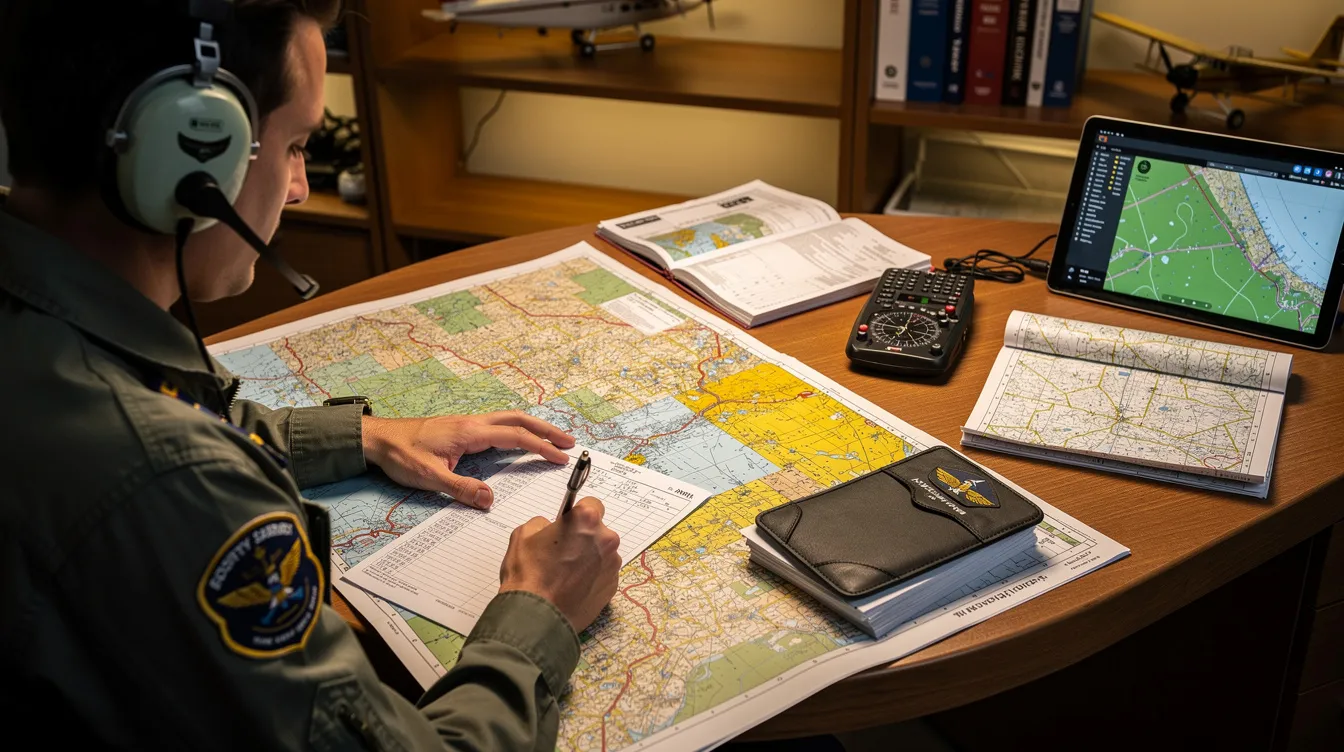
Aircraft Systems, Aerodynamics, and Emergency Procedures
The stuff they ask about in oral exams airplane systems, aerodynamic principles and what happens when things go pear-shaped all has its roots in some pretty core texts which you'll be expected to link to the ACS tasks in order to study effectively. I mean this is what the official exam questions are based on.
Systems knowledge typically covers:
-
Engine (e.g., Lycoming O-360, 180hp four-cylinder opposed)
-
Fuel system (gravity-fed, usable capacity)
-
Electrical (14V alternator, 13V battery)
-
Pitot-static (airspeed, altimeter, VSI failures from icing)
-
Vacuum (DG, attitude indicator operation)
The FAA Airplane Flying Handbook (AFH) will teach you how to do just about every flight maneuver, which in turn helps with understanding some pretty fundamental aerodynamics stuff.
You need to know about the four forces of flight, and the difference between induced and parasite drag, plus how planes tend to turn to the left when you need to turn right (or at least, why that is). And don't even get me started on stall theory at the critical angle of attack.
But here's the thing visual learning helps a lot, especially with the helpful figures in the PHAK and AFH. Read the text with the diagrams, they're not just for decoration.
Emergency procedures form a major focus area:
-
Engine failure cruise: pitch for best glide (C-172: 65-75 kts)
-
Engine failure after takeoff: land straight ahead below 500’ AGL
-
Electrical fire: master off, vents closed
-
Lost communications: squawk 7600, continue VFR
Risk management is pretty key: don't fly too low, or forget to check yourself off against the IMSAFE/PAVE checklists.
And you should be ready to explain that to your DPE because NTSB figures show that almost 30% of pilot decision errors are caused by these very same things the checklists cover.
ACS Maneuvers: What the Examiner Is Looking For
This section explains performance tolerances and common errors for key Private Pilot flight maneuvers. The ACS updates include significant reorganizations and new regulatory content to enhance clarity and usability for both instructors and students.
|
Maneuver |
Altitude |
Heading |
Airspeed |
Bank |
|---|---|---|---|---|
|
Steep Turns |
±100’ |
±10° |
60-100 kts |
±10° |
|
Slow Flight |
±100’ |
±10° |
±10 kts |
— |
|
Stalls |
±100’ |
±10° |
±5 kts |
<20° |
|
Ground Reference Maneuvers |
±200’ track |
±20° correction |
— |
— |
Ground reference maneuvers test your ability to maintain a consistent ground track while compensating for wind—a lot of students struggle with the mental workload here.
For takeoffs and landings:
-
Normal: 65 kts rotate, Vx/Vy climb
-
Short-field: barrier clearance, 59 kts rotation
-
Soft-field: continuous motion, no wheel braking
Common errors causing 40% of busts include chasing airspeed rather than pitch attitude and poor clearing turns. Checklist usage, clearing turns before maneuvers, and positive exchange of controls (“your aircraft,” “my aircraft”) are small but critical skill and risk management elements that examiners watch closely.
Oral Exam Prep: Sample Questions and Scenario-Based Learning
This section gives you the lowdown on how to prep for the oral exam using the ACS tasks and creating real-world scenarios which is vital when it comes to highlighting those Knowledge tasks in the ACS as they're pretty much the core topics you'll be quizzed on.
The oral part of your checkride is going to be an actual conversation with the DPEs, rather than a multiple choice test it's all about being able to explain things in a way that makes sense.
And just to put your mind at ease the FAA doesn't actually publish the exact questions you'll be asked so you can forget about memorizing anything its all about getting a good grasp of the core concepts.
DPEs cluster topics into scenarios. A single question might probe:
-
Airspace entry requirements
-
Weather minima for that airspace
-
Diversion planning if conditions deteriorate
Common question types include:
-
Definition (What is Class D airspace?)
-
Regulation recall (What does 61.113 say about compensation?)
-
What-if scenarios (Engine failure at 3,000’ AGL what’s your plan?)
-
Problem-solving (Compute density altitude given these conditions)
If you want to get your head around the Private Pilot ACS then look for study materials that cover each task in detail including both the knowledge and the risk management sections.
AOPA's data shows that airspace knowledge is a major contributor to checkride failures 25% to be exact.
So if you bombed on that FAA written knowledge exam then you should focus on studying those weak areas the examiners will definitely be looking out for those on the oral checkride.
And don't forget to schedule some mock orals with your CFI a week or so out from the checkride - its a great way to find out where you're going wrong.
Checkride Day Strategy and Final Review Checklist
Good ACS knowledge must be paired with smart logistics and the right mindset. Study materials for the Private Pilot ACS are available in various formats, including Word documents, PDFs, and PowerPoint presentations, allowing for flexible learning options.
Pre-checkride paperwork checklist:
-
IACRA 8710-1 application filed
-
Knowledge test report with comments on weak areas
-
Logbook endorsements under 61.39 complete and current
-
Aircraft logs showing all required inspections
-
Photo ID and pilot certificate
If you're still preparing for the knowledge exam before reaching the checkride stage, it's worth researching where to take ppl written exam and scheduling your FAA knowledge test well in advance to avoid delays in your training timeline.
Now that the boring stuff is out of the way, let's talk about how to present yourself during the oral. Keep all your study materials right in front of you in an easy to use binder or tablet.
Fill it with your annotated ACS notes, navigation logs, weight and balance forms & performance charts. This shows you're on top of it and means you can find anything the DPE throws at you in the nick of time.
Morning of checkride:
-
Arrive early
-
Complete thorough preflight
-
Review high-risk items (airspace, emergencies)
-
Use repetitive self-quizzing on weak areas
The ACS represents minimum standards. Demonstrate sound judgment alongside technical skill. When you show the examiner you can learn from experience, make safe decisions under pressure, and continue improving after certification, you’ll earn that private pilot certificate with the confidence of a well-prepared aviator.
Download FAA-S-ACS-6B today, mark it up, and work through every task. Your checkride author is the ACS itself use it.
